Energy management
system
On-site control and monitoring of large energy resources, such as batteries, solar parks, boilers and chargers.
Built for
the whole site.
The EMS takes the technical role closest to the site: it controls, measures and integrates what produces, stores or consumes there. Its job depends on the site. Charging depots tend to start with load balancing and add market access over time; battery parks start on the markets and grow into the local optimization. Whichever end you start from, it is the same system, so the rest is there when you need it.
38 MW
Controlled today: batteries, solar parks and chargers
6
Battery manufacturers integrated
One EMS for
every resource on site
A site is rarely one machine. Chargers next to a battery, solar on the roof. The EMS runs them together instead of one system per vendor.
Multiple resources, one system
Several chargers and batteries under a single EMS, controlled with knowledge of each other rather than competing for the same connection.
Traded as one
For market access, several resources can be grouped and traded as one, with the EMS splitting the obligation across them.
Sensors and other devices
The EMS can integrate with other devices on site, such as sensors, when a project calls for it.
Supported resources
We build support for new resource types and manufacturers when there is a case for it. If your resource is not in the list, talk to us anyway.
| Resource type | Status |
|---|---|
| Batteries | Supported today, six manufacturers |
| Solar parks | Supported today |
| Electric boilers | Supported today |
| EV charging | Supported with load balancing |
| Industrial load | In development |
Behind the meter
Load balancing at the point of connection
The EMS balances the site's controllable loads against the size of the grid connection, so the site draws what the fuse allows and nothing trips.
Peak shaving
The EMS regulates consumption to avoid the peaks that drive up the grid fee, using the batteries and chargers it already controls.
Market access,
at a flat fee
When the site has capacity to spare, the EMS delivers it to the markets through the aggregator you choose. Market delivery stacks on top of the behind-the-meter optimization; the resource keeps doing its local job.
Your aggregator, your data
The EMS connects your site to the optimization platform you choose, and telemetry goes there directly.
Fixed price
The price is a fixed cost per installation plus a recurring fee. Market revenue is yours; we take no share of it.
Administration
without site visits
The EMS controls and monitors the whole site, and its administration UI is where you see that and act on it.
See how the site is doing
The power at the point of connection, which resources load balancing is holding back, and alarms and warnings from the resources themselves. The same view shows when a battery needs calibrating.
Act on it from the office
Restart a resource, set min and max state of charge, calibrate a battery, or adjust site-specific schedules and limits. Changes that would otherwise mean driving out.
Hardware & interfaces
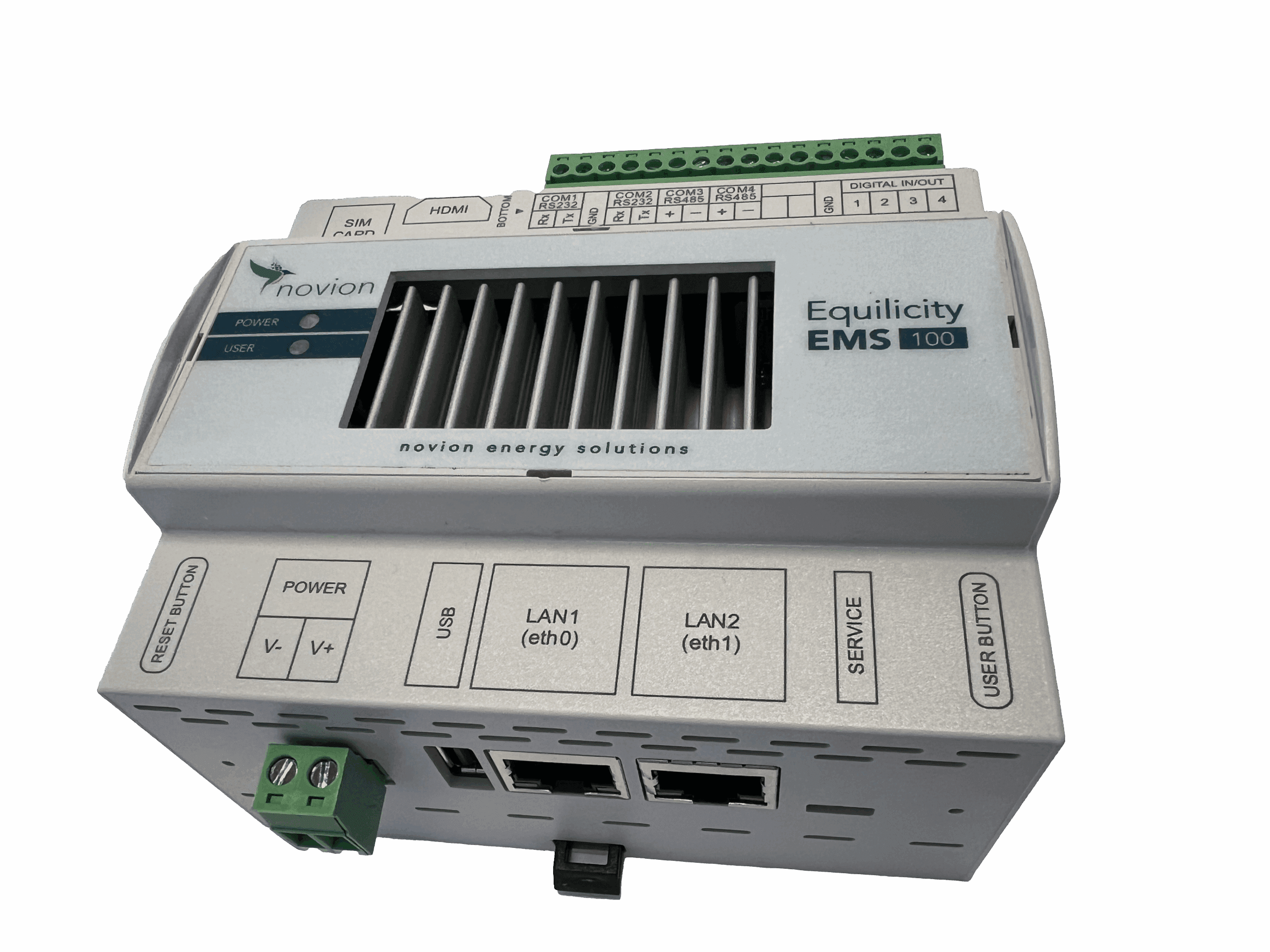
An industrial control unit mounted in the cabinet at the site, wired to each resource over the bus it already speaks.
Interfaces